Introduction
As global decarbonization accelerates and regulations such as the EU Renewable Energy Directive (RED II / RED III) are implemented, the International Sustainability and Carbon Certification (ISCC) framework has become a critical gateway for businesses entering the EU bioenergy, circular chemicals, and sustainable materials markets.
Both ISCC PLUS and ISCC EU cover the entire value chain—from feedstock collection to end products—placing heavy emphasis on feedstock traceability, supply chain transparency, and mass balance management.
However, for international buyers, relying solely on an ISCC certificate provided by a Chinese supplier is no longer sufficient to mitigate compliance and commercial risks.
Verifying supplier compliance effectively, while preventing greenwashing and supply chain disruptions, has become a top priority in international procurement.
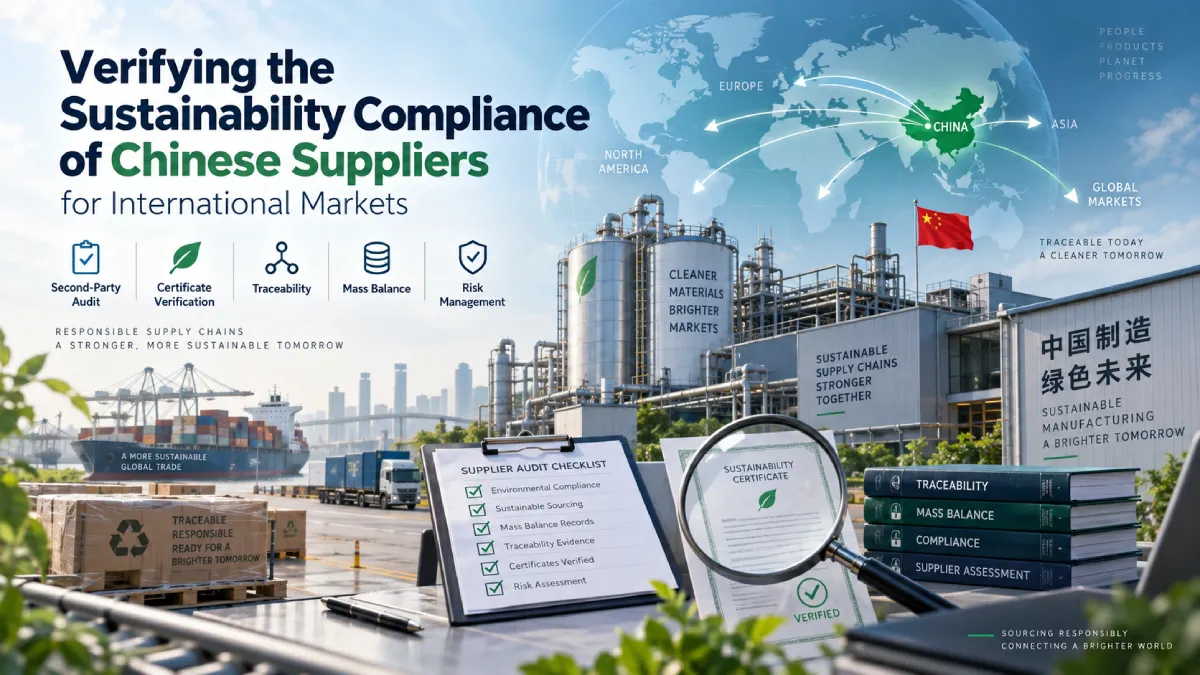
This guide outlines the necessity of second-party audits (2PA), key verification methodologies, and strategies for building long-term compliance management systems.
1. Second-Party Audits: Why They Are Essential
1.1 What Is a Second-Party Audit?
In supply chain compliance, three primary audit formats exist:
- First-Party Audit: Internal self-audits conducted by the company itself.
- Second-Party Audit (2PA): Direct audits performed by the buyer (or an independent professional firm delegated by the buyer) on its suppliers.
- Third-Party Audit (3PA): Independent certification audits conducted by accredited Certification Bodies (CBs).
A second-party audit evaluates suppliers specifically through the lens of the buyer’s risk profile and commercial requirements.
Given cross-border regulatory nuances, an increasing number of international buyers engage independent, local verification specialists in China to perform on-site second-party audits.
1.2 The Irreplaceable Value of Second-Party Audits
1. Third-Party Audits Are Point-in-Time Assessments
Third-party audits typically occur once a year over 1–2 days. Auditors assess a static snapshot of the plant operating under optimal conditions.
A CB’s role is to verify whether a plant demonstrates system capability, not to monitor whether every batch dispatched over the next 365 days remains fully compliant.
2. Hidden Risks in Upstream Supply Chains
ISCC mandates full end-to-end traceability (Farm / Collecting Point → Processing → Trader).
Many ISCC-certified processors or traders rely on fragmented upstream collection networks (e.g., UCO or industrial waste).
A valid certificate for a processing plant does not automatically guarantee that 100% of its upstream feedstock is genuine or free from double counting.
3. The “Certificate on the Wall” Disconnect
Some local suppliers lack an in-depth understanding of strict EU regulations (e.g., RED III, EUDR), viewing ISCC certification merely as a one-time transaction.
Without continuous internal compliance controls, day-to-day operations, bookkeeping, and mass balance accounting can quickly drift away from ISCC standards.
4. Real-World Revocation Risks
In recent years, several ISCC certificates held by Chinese bioenergy and recycled material producers have been suspended or withdrawn.
For instance, a facility in South China had its certificate revoked due to a minor procedural discrepancy: signing an outdated date on a newly updated ISCC template in its Sustainability Declaration (SD).
For international buyers, if a supplier’s certificate is revoked, all purchased materials instantly lose their sustainable status, exposing the buyer to severe financial and legal liabilities.
1.3 The Unique Perspective of Second-Party Auditing
While third-party audits verify compliance against a general standard baseline, second-party audits evaluate whether a supplier’s actual operations meet the buyer’s specific risk thresholds.
Second-party audits deliver:
- Tailored Deep-Dives: Customized verification focusing on specific parameters (e.g., feedstock origin, actual GHG intensity values).
- Cross-Verification of Physical and Bookkeeping Flows: Going beyond paperwork to reconcile ERP data, weighbridge tickets, warehouse logs, and physical production runs.
- Dynamic Risk Management: Transforming annual spot-checks into continuous, batch-level, and quarterly risk monitoring.
2. How to Effectively Verify Chinese Suppliers
2.1 Certificate Verification: Necessary, But Not Sufficient
Validating that a supplier holds an active ISCC certificate on the date of dispatch is the first step.
Buyers should verify via the official public ISCC database:
- Status: Status: Ensure the certificate status is “Valid” (not “Suspended” or “Withdrawn”).
- Site Address: Confirm that the operational address on the certificate matches the actual dispatch location.
- Scope & Materials: Ensure the certified scopes and material categories match the exact products being purchased.
2.2 Document Audits: Looking Beyond the Certificate
An effective second-party audit involves a thorough review of the supplier’s management documentation, including:
- Management System Files: Quality manuals, document/record control procedures, internal audit reports, and risk assessment frameworks.
- Traceability Records: Purchase contracts, invoices, weighbridge tickets, inventory logs, Sustainability Declarations (SD / PoS), and upstream supplier certificates along with Self-Declarations.
- Mass Balance Ledgers: Verifying that mass balance accounting is maintained on a strict site-specific basis with logical continuity.
- Training & Internal Audit Logs: Ensuring personnel in procurement, QC, warehousing, and finance are trained on current ISCC SOPs.
2.3 On-Site Audits: From Paper to Physical Reality
On-site verification is critical for identifying operational compliance risks.
Key areas of focus include:
Upstream Feedstock Traceability
Randomly sampling historical dispatches and tracing them backward to origin collection points, confirming that physical receipts, weighbridge data, and transport waybills match bookkeeping records 100%.
Mass Balance Execution & Deficit Prevention
- Confirming no negative balance exists at the end of any mass balance period (strictly prohibited under ISCC rules).
- Ensuring mass balance accounting periods for processing and trading units do not exceed 3 months to prevent improper credit borrowing across quarters.
- Verifying that Conversion Factors (CF) reflect actual historical production yields rather than theoretical design defaults.
GHG Calculation Audits
If actual GHG values are declared, auditors must cross-check raw energy utility bills (electricity, natural gas), chemical additive inputs, and transport distance records for authenticity.
2.4 Batch-Level Verification of Sustainability Declarations (SD / PoS)
Sustainability Declarations are legal instruments that transfer sustainability attributes along the supply chain.
For every shipment, buyers should verify:
- The supplier held a valid certificate on the exact date the SD was issued.
- The physical shipment volume, feedstock type, and GHG values strictly match the information listed on the SD.
- The supplier used the latest official ISCC SD template, with logical alignment between execution dates and signatures.
3. Building a Long-Term Supplier Compliance Management System
3.1 Implementing Risk-Based Supplier Categorization
Segment suppliers based on strategic importance, feedstock risk exposure, and past compliance performance:
- High-Risk / Strategic Suppliers: Require pre-qualification on-site 2PAs, quarterly ledger audits, and annual re-audits.
- Medium / Low-Risk Suppliers: Perform desktop document reviews, batch-level SD validation, and automated certificate monitoring.
3.2 Supporting Supplier Capacity Building
The ultimate goal of a second-party audit is not merely finding fault, but fostering long-term supplier capability.
Providing compliance guidance, sharing official ISCC system updates, and assisting local suppliers in optimizing internal SOPs helps transition their mindset from “audit preparation” to standardized, daily compliant operations.
3.3 Establishing Real-Time Monitoring and Alert Systems
- Automated Certificate Tracking: Maintain a centralized database to monitor supplier certificate statuses regularly.
- Batch-Level Escalation Controls: Set up clear protocols to hold shipments and payments immediately if inconsistencies or certification irregularities are detected in SD documentation.
3.4 Integrating 2PAs into the Procurement Lifecycle
Embed second-party auditing into every stage of supplier relationship management: from initial onboarding screening and contractual clauses (mandating audit cooperation) to routine purchase orders and annual performance evaluations.
Structuring clear contractual liabilities for certificate revocation reinforces accountability across the supply chain.
Conclusion
In an era of tightening global sustainability regulations, third-party certification provides a necessary compliance baseline, while buyer-driven second-party auditing builds a robust defense against greenwashing and supply chain disruptions.
Conducting independent second-party audits and verifying operations directly on the ground transforms compliance from a static paper exercise into genuine supply chain resilience.
This proactive approach enables international buyers to manage risk effectively and maintain a competitive advantage in global markets.