Introduction
In the transition toward a circular economy and bioeconomy, one of the most significant challenges companies face is tracking sustainable materials through complex, multi-stage supply chains.
When recycled or bio-based feedstocks are mixed with conventional fossil-based materials during manufacturing—as is often unavoidable in chemical production—how can a company credibly claim that its final product contains sustainable content?
The answer lies in mass balance, a chain of custody method that has become the prevailing standard in the chemical industry and beyond.
This article explains how ISCC mass balance works, why it matters for sustainable material traceability, and how companies can implement it effectively.
1. What Is Mass Balance?
1.1 Definition and Core Concept
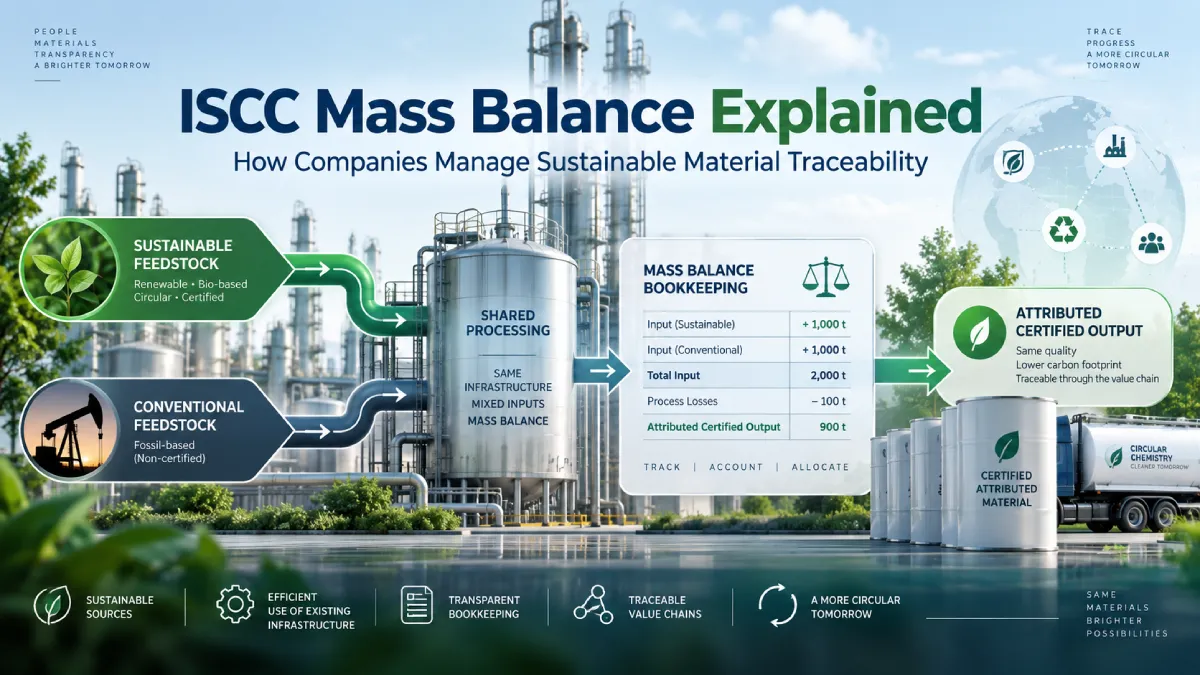
Mass balance is a chain of custody method in which certified and non-certified materials can be physically mixed during storage, transport, or processing, but are kept segregated on a bookkeeping basis.
In other words, while sustainable and conventional materials flow through the same pipes, tanks, and production lines, the company maintains meticulous records that track exactly how much certified material entered the system and how much can be attributed to the outputs. article2
Mass Balance Flow
INPUTS
[ Certified Feedstock ] + [ Fossil Feedstock ]
                    │
                    ▼
PROCESS
[ Shared Processing Line / Tank ]
                    │
                    ▼
[ Physical Mixture ]
                    │
                    ▼
BOOKKEEPING
[ Mass Balance System ]
                    │
                    ▼
OUTPUT
[ Attributed Certified Output ]
This distinct accounting method verifies that certified feedstock has replaced an equivalent quantity of fossil raw materials at the beginning of the supply chain and can be attributed to the sold product.
The fundamental governing principle is straightforward:
No entity can claim more certified products than they sourced.
1.2 Why Mass Balance Is Necessary
In chemical manufacturing, input materials of different origins—such as recycled pyrolysis oil, bio-naphtha, and fossil feedstocks—are routinely blended.
This is particularly true in capital-intensive industries with continuous-flow production assets (e.g., steam crackers) where certified and non-certified materials cannot be processed in segregated lines.
Physical segregation would require building parallel infrastructure, which is economically and practically infeasible.
Mass balance provides a scalable, practical solution allowing companies to integrate renewable and recycled feedstocks into existing infrastructure immediately.
As ISCC notes, mass balance is currently the most viable framework to scale circular and bio-based feedstocks. article2
2. ISCC Chain of Custody Options
ISCC offers multiple chain of custody options to accommodate different industry value chains:
Physical Segregation
Certified materials are kept physically separate from non-certified materials throughout storage, processing, and transport.
Characteristics:
- Highest rigor
- Requires dedicated tanks, lines, or storage facilities
Controlled Blending
Sustainable and non-sustainable feedstocks are blended with precisely defined and measured proportions.
Characteristics:
- Intermediate flexibility
- Requires precise physical ratio tracking
Mass Balance
Certified and non-certified materials are physically mixed but logically tracked and separated via precise bookkeeping.
Characteristics:
- Most practical for continuous, highly complex chemical and refining assets
Scheme Application
- ISCC EU: Permits Physical Segregation and Mass Balance.
- ISCC PLUS: Permits all three chain of custody models. article2
3. The Rules Governing Mass Balance
Mass balance operates under robust, multi-stakeholder standards designed to prevent greenwashing and ensure full accountability.
3.1 Core Principles
Site-Specific Accounting
Mass balance must be maintained on a site-specific basis.
Company-wide or multi-site credit pooling is strictly prohibited. Every physical plant must maintain its own dedicated balance sheet.
Physical Flow Alignment
Bookkeeping entries must strictly reflect the actual physical movement of materials into and out of the operational site.
No Negative Balance
A negative mass balance—occurring when more certified material has been dispatched/sold than received or held in stock—is strictly forbidden at the close of any accounting period.
If a deficit occurs, the company must notify its Certification Body (CB) immediately.
Credit Rollover
At the end of a mass balance period, the account must be balanced or carry a positive credit balance to be rolled forward. article2
3.2 Mass Balance Periods
Standard Operators
Capped at a maximum period of three months (quarterly or monthly ledger tracking).
Agricultural/Forestry Exception
Extended to 12 months strictly for agricultural/forestry producers and first gathering points directly sourcing from origin.
Continuity Requirement
Mass balance periods must be uninterrupted.
No accounting gaps are permitted between periods, even during operational downtime or periods without sustainable material flows. article2
3.3 Credit Transfer Between Certification Cycles
Unused credits may be carried forward across certification renewal cycles.
If a gap of up to three months occurs between the expiration of a certificate and recertification, credit transfers remain permissible only if:
- No physical sustainable material entered or left the site during the uncertified gap.
- Physical stock on site never dropped below the credit volume being transferred. article2
4. The Mass Balance Calculation
4.1 The Basic Formula
Mass balance accounting is governed by the following mathematical model:
B = (A + a) × CF + b
Where:
- A: Sustainable input material received during the mass balance period
- a: Starting inventory of sustainable input material at the beginning of the period
- b: Starting inventory of sustainable output material (for processing units)
- CF: Average Conversion Factor for the operational period
- B: Total available sustainable output credit
- C: Sustainable output dispatched/sold during the period
Closing Conditions
- B − C = 0: Balanced ledger (zero credits remaining)
- B − C > 0: Positive balance (credits available for carryover)
- B − C < 0: Non-compliant negative balance (Violation)
Note: For storage, distribution, or non-processing operations without quantitative transformation, CF = 1.0. article2
4.2 Conversion Factors (CF)
Conversion factors compensate for yield losses during manufacturing and must be established using actual historical operational data rather than theoretical estimates.
Formula:
The original document presents this formula graphically on page 3.
4.3 Certified Share Calculation
The percentage of certified input entering a processing stream is expressed as:
This formula is also shown graphically on page 3 of the source document.
4.4 Implementation Methods Under ISCC PLUS
Rolling Average Percentage Method
The certified content is calculated as a weighted average percentage across all output batches produced during a defined period.
Credit Method
Credits generated from certified inputs are accumulated in a credit account and freely attributed to specific eligible output batches, allowing targeted marketing of 100% attributed sustainable products. article2
5. How Mass Balance Enables Traceability
5.1 The Traceability Chain
Every node in an ISCC-certified supply chain must prove compliance.
The mass balance system ensures that:
- Materials with varying sustainability criteria (e.g., UCO, bio-naphtha, circular polymers) can be physically co-processed.
- The sustainability attributes and greenhouse gas (GHG) values remain fully traceable within the overall mix.
- Outgoing Sustainability Declarations (SD) accurately convey the verified attributes to downstream buyers. article2
5.2 Attribution vs. Physical Tracking
Mass balance separates physical routing from attribute allocation.
Physical Tracking
Monitors the total volume of verified sustainable feedstock entering a production site.
Attribution
Allocates the sustainability credentials to output products.
Under ISCC PLUS, chemical connectivity acts as a crucial guardrail: credits can only be attributed to outputs that are chemically derived from, or connected to, the certified input stream within the same manufacturing complex. article2
6. Real-World Applications
Chemical Recycling
Post-consumer plastic waste is converted into pyrolysis oil and fed into steam crackers alongside fossil naphtha.
Companies use ISCC PLUS mass balance to market 100% attributed recycled polymers.
Sustainable Aviation Fuel (SAF)
SAF is blended into conventional jet fuel pipelines and airport storage systems where physical segregation is impossible.
Mass balance tracks the environmental attributes for airlines and corporate buyers.
Bio-based Consumer Goods
Global brands utilize ISCC PLUS certified materials to replace fossil-derived ingredients in adhesives, detergents, and packaging without altering product performance or manufacturing setups. article2
7. Audit and Compliance Requirements
7.1 Key Documentation Checklist
During an ISCC audit, companies must present verified audit trails containing:
- Incoming and outgoing Sustainability Declarations (SDs) / Proof of Sustainability (PoS)
- Weighbridge tickets, bills of lading, and commercial invoices
- Empirical conversion factor calculations and engineering yield reports
- Mass balance ledger specifying exact start and end dates per period
- Physical inventory count records for certified and non-certified stocks article2
7.2 Audit Scrutiny & Error Thresholds
Auditors evaluate data integrity against strict margin-of-error thresholds:
- First Year of Certification: Maximum permissible accounting error rate is 3%.
- Second Year Onward: Permissible error rate drops to 1%.
Furthermore, under ISCC’s Audit Procedure System (APS v5.0), auditors mandate continuous, real-time ledger maintenance rather than retroactive preparation prior to audit day. article2
8. Strategic Summary for Implementation
To build a resilient ISCC Mass Balance compliance system, companies should adhere to six golden rules:
1. Maintain Site-Specific Rigor
Never aggregate bookkeeping across separate geographic sites.
2. Prevent Deficits Systematically
Integrate ERP safety controls to block sales orders if certified credit balances are zero.
3. Use Verified Data
Calculate conversion factors using actual, verifiable operational mass balances rather than design defaults.
4. Respect Accounting Windows
Align routine reporting with the standard 3-month maximum period.
5. Verify Supplier Credentials
Regularly check the official ISCC database to ensure supplier certificates remain active (Valid) at the time of material delivery.
6. Retain Records for 5 Years
Store all purchasing, production, and sustainability documentation for a minimum of five years to withstand retrospective audits. article2
Need Help Setting Up Your ISCC Mass Balance Ledger?
From setting up site-specific mass balance templates to performing pre-audit gap assessments, our expert consultants ensure your compliance system is audit-ready year-round.
Request a Free ISCC Compliance Consultation